Allan Mere Award for 2025:
Shannel Courtney
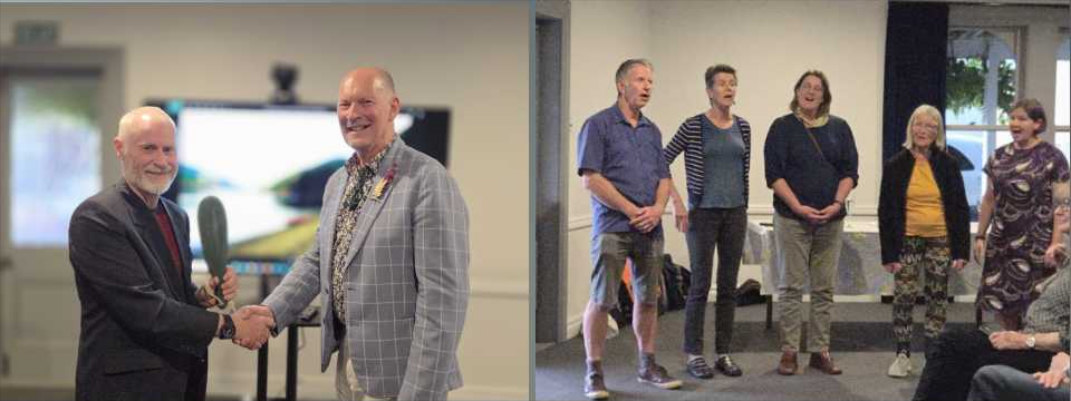
Left: Presentation of the Allan Mere to
Shannel by Anthony Wright, 3 November 2025.
Right: Following Shannel’s response to the presentation,
members of his choir Mosaic sang a beautiful waiata.
Tena koutou, tena koutou, tena koutou katoa
Kuia, koroua, nga mihi nui ki a koutou
Te Rangatira, Matua Shannel, tena koe
Tena koe whaea kaiwahakahaere Helen
Ko ahau te tumuaki matua o Te Whare Taonga o nga Pakihi Whakatekateka o Waitaha, ki Otautahi
Ko Anthony Wright ahau.
Tihei mauriora!
Nga mihi nui ki a koutou. I’m delighted to be here today to celebrate the life-time achievements of Shannel Courtney by making the 2025 presentation of the Allan Mere to him.
But first, a sincere thank you to the Nelson Botanical Society for hosting this event for the New Zealand Botanical Society. It’s a special pleasure to remember past local recipients of the Allan Mere – Cathy Jones and Bill and the late Nancy Malcolm, and to see Cathy here tonight to honour another awardee.
Before proceeding, I’ll give a little background to the award. The Allan Mere was donated by Dr Lucy Moore in 1982 to commemorate the 100th anniversary of the birth of Harry Howard Barton Allan, first Director of Botany Division of the former DSIR, and author of Volume 1 of the Flora of New Zealand.
The Allan Mere is awarded annually by the New Zealand Botanical Society from nominations made by Regional Bot Socs or individual members to persons who have made outstanding contributions to botany in New Zealand. The Mere normally resides at the Allan Herbarium at Manaaki Whenua Landcare Research in Lincoln, just south of Christchurch.
The New Zealand Botanical Society Committee has awarded the Allan Mere for 2025 to Shannel Courtney and it is my pleasure to present this award to a redoubtable man whom I believe I first met on an Offshore Islands Research Group expedition to the Chetwode Islands, a significant number of years ago. More about that in a moment.
The nomination was made by Helen Lindsay for the Nelson Bot Soc, supplemented by letters of support from the Wellington Bot Soc, the Canterbury Bot Soc, the Bot Soc of Otago, the Auckland Bot Soc, and Prof. Dr. Peter J. de Lange.
Turning the clock back – and Shannel will doubtless remember better than I do as he’s so much younger! – our probable first field trip together was the Offshore Islands Research Group expedition to the Chetwode Islands in the Marlborough Sounds in the last week of March 1984. Amongst my old offshore island files I found our immediate report and a copy of the budget for the trip. How different – how much simpler – the world was then! We chartered a small launch from Wellington, the ‘Lady Winn’, for the princely sum of $400. Yes, that includes coming across a second time to pick us up – one day early due to deteriorating Cook Strait weather. Food for the 10 people for the week cost slightly more at $433.62, and with outboard fuel and gear hire, led to a total trip cost of $100 for those yet to find employment and $105 for those of us in our first job. The Treasurer noted a worrying excess of expenditure over income of $7.02!
But back to Shannel’s career since then, which has all been on the profitable side of the ledger. Usually, one of the especial pleasures of the nomination and award process is learning more about botanical enthusiasts I thought I already knew pretty well. In Shannel’s case, I knew the general range of his extraordinary achievements, but there are details which were new to me, and I’ll share some of those achievements with you now.
After completing his MSc studying pingao ecology on Kaitorete Spit, Shannel has made an outstanding contribution – in professional, personal and voluntary capacities – to the recognition, understanding, documentation and conservation of the indigenous plants of Aotearoa New Zealand. He held professional botanical and conservation roles in Te Papa Atawhai the Department of Conservation (and its predecessors) for almost 40 years, ‘retiring’ in 2023 from the position of Threatened Plant Technical Support Officer for Nelson-Marlborough.
Notable achievements include the completion of baseline botanical surveys to provide a comprehensive range of plant species lists for over 2 million hectares of public conservation land in Te Tau Ihi, the top of the South Island; leading the Protected Natural Area Survey of the Ecological Districts of the mighty Molesworth Station; documenting the ecosystems, vegetation types and species of inland Marlborough; and the establishment of permanent vegetation monitoring transects to better understand the impacts of grazing.
Shannel’s deep and extensive knowledge of the New Zealand flora and ecosystems, particularly those of Te Tau Ihu, means that he is acknowledged as an expert in his field by professional peers, iwi, and the wider botanical and conservation communities alike. He is a collaborator, helping assess the national vascular plant flora’s conservation status for more than 25 years, and co-authoring the resolution of the taxonomic status of 12 new species and 6 new-subspecies, as well as pin-pointing numerous further new taxa for taxonomic description. Notable examples of amazing finds range from the new endemic daisy genus Rachelia to the rediscovery of the Pygmy Goosefoot in 2015 at Molesworth after it had not been seen since the 1940s and was presumed extinct.
Shannel led the DoC National Plant Species on the Brink Programme, helped develop the relationship with Botanic Gardens for ex-situ plant conservation, and wrote the myrtle preservation strategy following the arrival of myrtle rust in New Zealand.
Shannel has a deep understanding of Te Ao Māori and a high degree of fluency in Te Reo. He works closely with iwi to document endemic and threatened plants in their rohe and assists in developing strategies for their conservation. Of course, he knows a lot about this through the practical experience and hard mahi of restoring his own six hectares of coastal northern rātā-podocarp-mixed broadleaf forest on limestone bluffs at Pōhara in Golden Bay.
Shannel is no stranger to other parts of the country either: John Barkla, writing for the Botanical Society of Otago, notes “our Society and the wider botanical community in Otago and Southland have benefitted from his field work and species lists. Most notable are his contributions from the Sub-Antarctic islands, Whenua Hou, and the Nevis Valley. Most recently, he made significant contributions to a new Otago Regional Council report titled ‘Conservation status of indigenous vascular plants in Otago, 2025’.
The other regional bot socs have also written praising Shannel’s generous sharing of knowledge, expertise, talks and field leadership.
Which leads us closer to home, and the pivotal role Shannel has played in your own Nelson Botanical Society. In 1989, along with three others (Graeme Jane, Peter Williams, Bill Malcolm) he established the society, and has been an active member of the committee for 35 years. He leads 6 to 8 trips and multi-day camps every year, writes and reviews reports on these, and is botanical editor of the society’s popular quarterly newsletter. In a fitting recognition of all this, he was recently made a Life Member of the Society.
Shannel is a generous and inspiring mentor and colleague to botanists – professional and amateur alike – and to the iwi of Te Tau Ihu. He helps spread the word by providing his expertise to the authors of important botanical books and publications. Thank you all for coming to do honour to Shannel today, and thanks again to President Helen and the Nelson Botanical Society for hosting the event, and to all those who made and supported the nomination.
I’d now like to read out the formal citation entered into the Allan Mere Book of Record:
Shannel Courtney
Over four decades, Shannel has made an outstanding contribution – professionally, personally and voluntarily – to the recognition, understanding, documentation and conservation of the indigenous plants of Aotearoa New Zealand. His deep and extensive knowledge of the flora, particularly that of Te Tau Ihu, the top of Te Wai Pounamu, has seen him acknowledged as expert by professional peers, iwi, and wider botanical and conservation communities. Shannel is a generous and inspiring mentor and colleague to all.
At this point in the proceedings, I normally remind recipients that it was one of Lucy Moore’s rules that the Mere be kept safe at the Allan Herbarium, and only “let out” for the presentation ceremony. However, Shannel does get to hold the Mere for the rest of the evening, receives a framed, inscribed certificate to mark the award, and will in due course receive a bound set of the nomination, announcement and award papers.
When I rang Shannel to let him know that he’d be the 2025 awardee, he was I think a trifle shocked, but recovered quickly, chuckled, and said “I thought by the end of last year that all the awards were over!” If I’d been quicker off the mark, I might have responded “We’ve kept the best till last!” So, congratulations to you Shannel Courtney – I have the greatest pleasure in presenting you with the Allan Mere for 2025.
Anthony Wright, President, New Zealand Botanical Society
Citation reproduced from the New Zealand Botanical Society Newsletter, No. 162, Dec 2025.